
Batja Mesquita
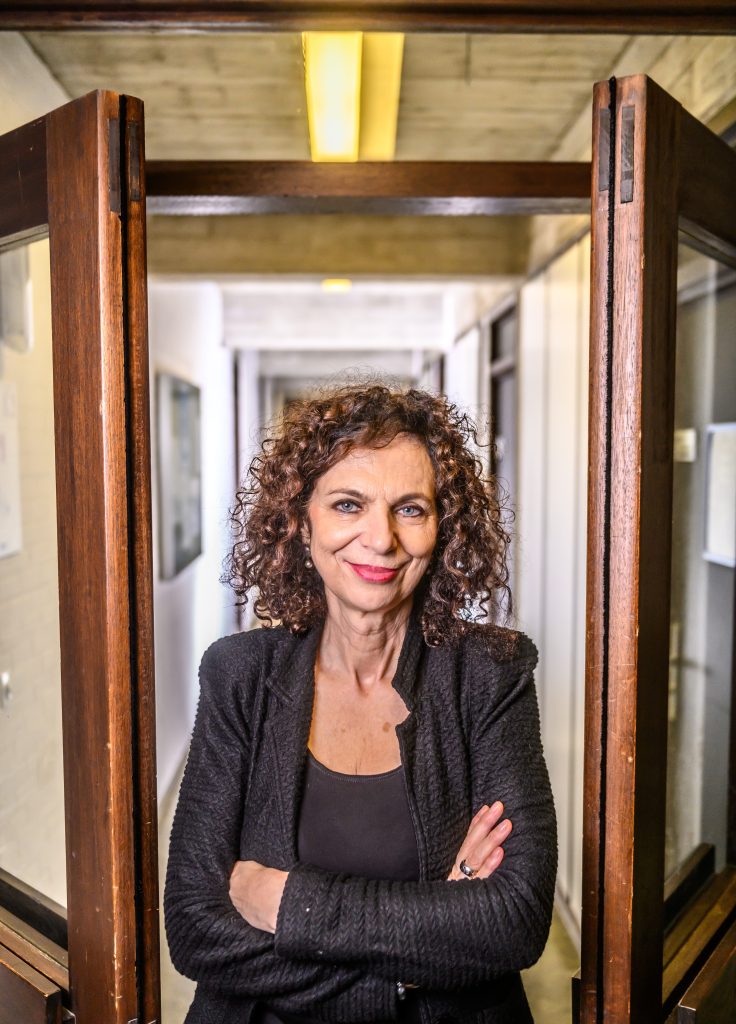
Batja Mesquita is a social psychologist, an affective scientist, and a pioneer of cultural psychology. She is a professor of psychology at the University of Leuven, Belgium, and director of the Center for Social and Cultural Psychology at the University of Leuven. Before coming to Leuven, she was affiliated to Wake Forest University, the University of Michigan, Stanford University, and the University of Amsterdam. Mesquita is one of the world’s leading authorities on the psychological study of cultural differences in emotions. Her most recent research focuses on the role of emotions in multicultural societies. She studies how emotions affect the belonging of minoritized youth in middle schools, and the social and economic integration of “newcomers” (i.e. newly arrived immigrants). Mesquita has been a consultant for UNICEF and the WHO, and most recently, she was a member of the core group of scientific advisors for the Happiness and Well-being (SEH) Project, and initiative of the Vatican in partnership with the UN Sustainable Development Solutions Network (SDSN).
Title: MINE and OURS emotions
Western folk theory understands emotions as MINE: Mental feelings, INside the person, and Essences. In this talk, I will juxtapose this MINE-model to an OURS-model that casts emotions as OUtside the person, Relational acts, and Situated. I will revisit both old and new data, and suggest that emotional processes in non-Western cultures are often better aligned with an OURS- than a MINE-model of emotions. I will discuss possible consequences for psychological theory of emotions.
Monica Tentori

Dr. Mónica Tentori is a researcher at CICESE specializing in ubiquitous computing, artificial intelligence, and human–computer interaction. Her work has focused on designing technologies that impact health and well‑being in real-world contexts.
She has been recognized with the Microsoft Research Faculty Fellowship, being the only Latin American woman and the only Mexican to receive this distinction. In addition, she is the first woman from Ensenada to be named a distinguished citizen for her contribution to technological innovation.
She is a member of the National System of Researchers (Level II) and has played an active role in the national and international scientific community, contributing to the development of ubiquitous computing and human–computer interaction.
Title: From Interaction to Perception: Sensing and Shaping the Invisible
Affective computing has long focused on sensing the invisible—inferring emotion, stress, and cognitive states from what people do. Yet, the way we interact with technology reveals something deeper: not only how we feel, but how we experience the world.
In this talk, I explore interaction as a window into perception. From the way we navigate apps to how we touch and move, subtle patterns of interaction can reveal dynamics of attention, anxiety, and neurocognitive differences. These interactions are not just behavioral traces—they are expressions of how experience itself is constructed.
This perspective opens a new possibility. If interaction reflects perception, and perception shapes what we feel, then the systems we design are already part of that process. By shaping how people perceive and engage with the world, we begin to move from sensing the invisible to shaping it.
IVA Keynote
Antonia Hamilton

Antonia Hamilton is Professor of Social Neuroscience at the Institute of Cognitive Neuroscience, University College London. She completed a PhD on computational neuroscience at UCL (2002) and has since worked on autism, cognitive neuroscience, social behaviour and human brain imaging. Drawing on expertise in precision motion tracking and real-world behaviour, her lab aims to capture and understand the information processing mechanisms that support real-world social behaviour, enabling virtual humans to then show appropriate interactive behaviours. The research is inherently interdisciplinary, using methods from psychology, computing, engineering, theatre, child development and neuroscience to understand human social interaction.
Hamilton’s lab has been funded by the European Research Council, the Leverhulme Trust, the ESRC and others, and her contribution was recognised with the 2013 Experimental Psychology Society prize lectureship and a 2021 Lundbeck visiting Professor position at the University of Copenhagen. She has published over 150 papers and is the Editor in Chief of the Quarterly Journal of Experimental Psychology and a fellow of the Association of Psychological Science.
Title: Mechanisms of human interactive behaviour and their application to virtual interactions